Supporting Semi-Nomadic Communities and Snow Leopard Conservation in the Jomolhari Landscape

The Jomolhari Landscape, renowned for its charismatic snow leopards and their prey, is also home to about 160 semi-nomadic people and approximately 3,000 yaks. These communities face significant challenges, particularly the predation of yak calves by snow leopards. To foster community support for snow leopard conservation, the Bhutan Foundation, in collaboration with the Royal Government of Bhutan, has been incentivizing these communities through various livelihood programs.

Traditionally, semi-nomadic people used labor-intensive “Bja” tents. However, most herders have now shifted to flimsy tarpaulin sheets, which are less durable and contribute to plastic waste in the pristine alpine habitat. To address this issue, the Bhutan Foundation, in partnership with the Department of Forest and Park Services, Ministry of Energy and Natural Resources, has distributed 78 modified tents to yak herders in the Jomolhari Landscape, reducing the reliance on tarpaulin.

These new tents are durable, spacious, and well-ventilated, minimizing herders’ exposure to indoor pollution while providing warmer living conditions. Their portability makes them ideal for the nomadic lifestyle.

Furthermore, the Bhutan Foundation, in collaboration with the Department of Livestock, has provided an additional 91 tents on a cost-sharing basis (80:20) to herders in Yaksa, Soe, Naro, Nubri, Lingzhi, and Katsho, Bjee, and Esue gewogs under the Jigme Khesar Strict Nature Reserve (JKSNR), a known snow leopard hotspot.
Lingzhi Gup shared that herders typically purchase two to three plastic tents each year, depending on the herd size. These tents last a maximum of one year, after which they become waste that pollutes the alpine meadows. Additionally, herders need wooden poles to pitch the tents, exerting pressure on the alpine forests. “With these new, modified tents, we not only reduce plastic waste and the demand on alpine forests for poles, but also alleviate the economic burden on highlanders,” said the Gup.

His Excellency, the Minister for the Ministry of Agriculture and Livestock, officially handed over the tents to beneficiaries from highland communities in Thimphu District. The ceremony was attended by the Director of the Department of Livestock, Dasho Dzongda, and local government leaders.
 

This initiative builds on our previous support to herders in the snow leopard range, including the communities of Yaktsa, Soe, Nubri, Lingshi, and Bumthang. To date, 169 herders have benefited from this initiative.
Through these efforts, we aim to enhance the living conditions of semi-nomadic communities while promoting snow leopard conservation, ensuring a sustainable and harmonious coexistence in the Jomolhari Landscape
Share This Post

Help share our latest news and updates with your network.

Subscribe Now

Get inspiring stories, project updates, and opportunities to make a difference.

Latest News, Updates & Announcements

Bruce Bunting Scholarship Recipients 2026

Bruce Bunting Scholarship Recipients 2026

The Bruce Bunting Scholarship for Environmental Leadership continues to support Bhutanese professionals in building the knowledge…

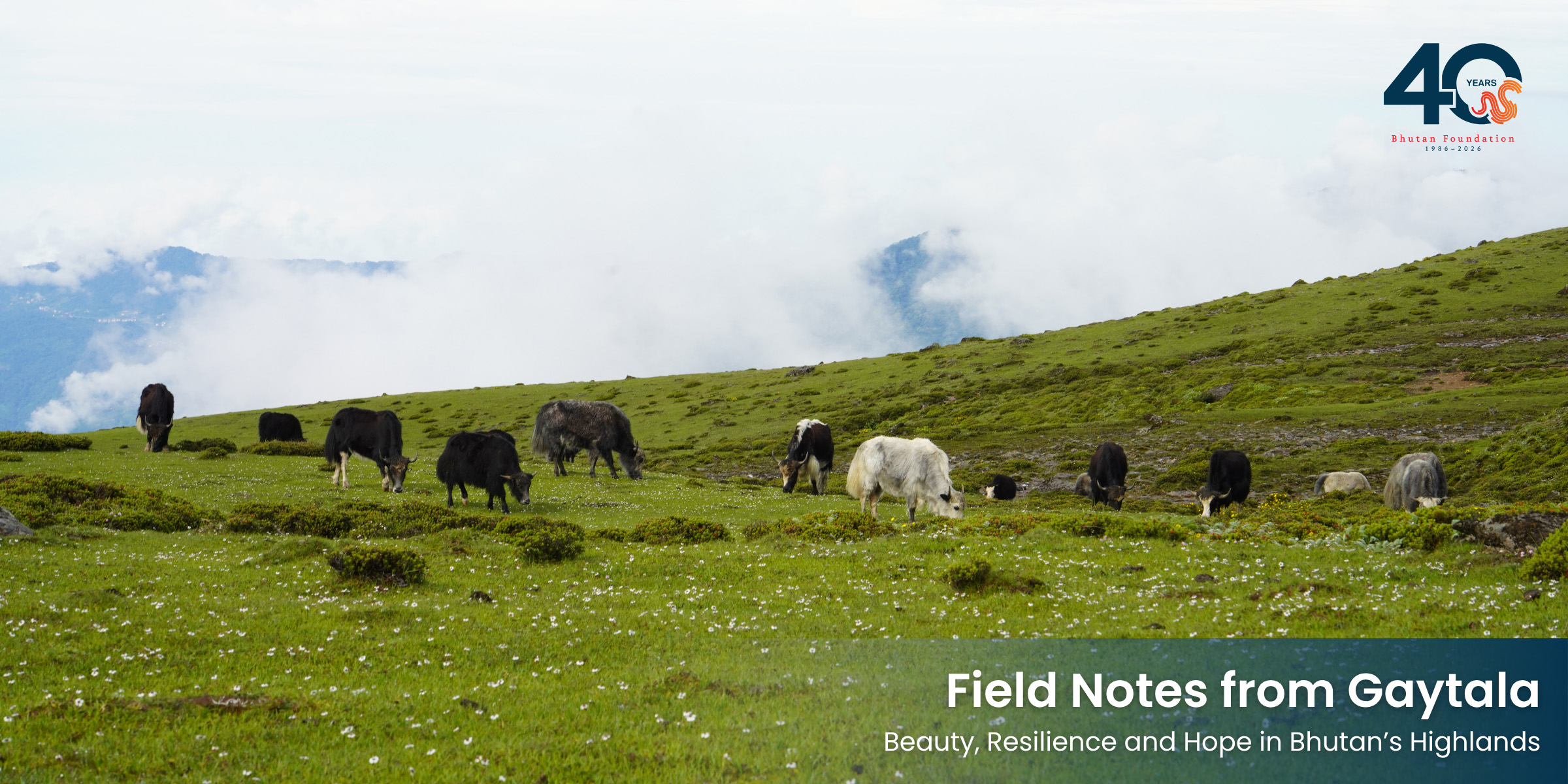
Field Notes from Gaytala

Field Notes from Gaytala

Beauty, Resilience, and Hope in Bhutan’s Highlands Many of the Bhutan Foundation’s programs reach…

Thirty-One Years on the Frontline

Thirty-One Years on the Frontline

For 31 years, Dorji Wangchuk has walked Bhutan’s forests with a responsibility that extends…

Advancing Pangolin Conservation in Bhutan

Advancing Pangolin Conservation in Bhutan

Bhutan is home to two pangolin species: the Critically Endangered Chinese pangolin (Manis pentadactyla)…

Help Build a Stronger Bhutan

Every gift creates lasting change.

Your support will help:

Conserving Bhutan's rich biodiversity and pristine landscapes.

Creating opportunities for children and young people to succeed.

Improving access to quality healthcare and essential services.

Protecting Bhutan's traditions, heritage, and identity.

Other Ways to Give

Make a Wire Transfer

Please contact Ms. Pemma Lhazin at +1-202-609-7363 or pemma.lhazin@bhutanfound.org

Make a Stock Gift

Please contact Ms. Pemma Lhazin at +1-202-609-7363 or pemma.lhazin@bhutanfound.org

Mail a Check

The Bhutan Foundation
1050 Connecticut Ave NW
#66013
Washington, DC 20036

A Gift in Your Will:

There are several ways to make a bequest to the Bhutan Foundation through your will or other estate plans: a residual bequest, a percentage bequest, a specific bequest, or a contingent bequest. Whichever type of bequest you choose, please use the following language:

“I give, devise, and bequeath to the Bhutan Foundation, Inc. (“Foundation”) (EIN: 13-3376290), an Internal Revenue Code section 501(c)(3) organization organized in the State of Delaware, or its lawful successor, the sum of $ _____ [or a percentage of my estate] to be used exclusively for purposes of promoting the Foundation’s charitable mission (the “Purpose”).”

Tax ID Number: 13-3376290

The Bhutan Foundation is a 501(c)(3) registered charitable organization in the United States. Your contribution is tax-deductible to the extent allowed by law.

Stay Connected to Bhutan

Get inspiring stories, project updates, and opportunities to make a difference.

↑